
Dr. Richard Olof Sorensen
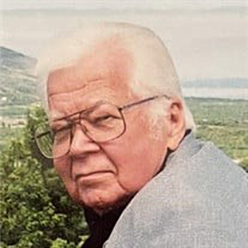
This page is a tribute to my faculty advisor and primary art history professor at Furman University in Greenville, South Carolina, Dr. Richard Olof Sorensen. It was with great sadness that I learned recently that he had passed away at the age of 86 on April 6, 2022. Although I have loved art my entire life, it was really Sorensen who truly fostered that love, who helped me learn to appreciate the different periods and styles of art.
I first met Sorensen during winter term 1975 at Furman University where I was an art history major. I had been away from campus for the fall term as a participant in Furman’s Fall Term in Paris 1974 program. Sorensen, who was Professor Jim Lawless’s replacement, was already on campus. That winter term I had Sorensen for a course in classical (Minoan/Mycenaean, Greek, Etruscan, and Roman) art. He was a really good professor. He truly cared — he cared about his students, about art, about his family and friends, about life. He adored his wife Joan and their young son, Trygve. When he arrived on the Furman campus, he was still working on his doctorate. After he had earned the Ph.D. in Comparative Arts, we (his students) asked him if we should address him as “Dr. Sorensen.” “No,” he said, “Sorensen is fine.” He once said we could call him “Olof” after we graduated. I never did that though. He was always “Sorensen” to me.
Sorensen faced very stiff competition when he applied for and was hired for the Furman job. He was chosen at least partly because he was so well qualified to teach both studio art and art history. He was a fine painter in his own right.
He must have wondered sometimes exactly what he was getting into. There was no art building at that time. Instead some art studios and the main art department office were located in the classroom building. The printmaking studio was in the basement of the science building. This was also where Psychology Department was and where the laboratory animals were kept. In other words, the art department was a bit scattered! Sorensen’s office was in the classroom building as well — underneath a staircase. In a former life, it could have been a broom closet. This was no commentary on Sorensen as a person or professor though — he inherited this space from his predecessor.
The Art Department would eventually have much nicer quarters. Although this happened after I had graduated from Furman, the Thomas Anderson Roe Art Building was completed in 1986. Sorensen helped in the design of this stunning building and also was instrumental is raising funds for its construction.
Sorensen served as Chairman of the Art Department from 1977-83 and again from 1989-94. He retired in 2003.
As I mentioned above, my first class with Sorensen was about Greek and Roman art. I remember one day we were taking a test. It is usual when you are taking an exam that the teacher sits at a desk upfront and waits for the test papers to be turned in. On this day Sorensen seemed unusually nervous. He paced around the lecture hall. He seemed agitated. Later I asked a classmate about his demeanor and was told that he was worried because he had misplaced the Art Department’s counting device that kept track of the xeroxed copies made by the department. Some time later I needed to make some copies for a class presentation. Sorensen handed me this small box-like item and instructed me to plug it into the copy machine. That way I could make my class presentation hand-outs. I had to smile when I saw a label with a skull and crossbones drawn on it and the neatly printed words “Do not lose.” Immediately my mind went back to that test day.
I also recall a springtime day in his first year at Furman that he practiced his best Southern accent by repeating the word camellia over and over again. Although he really tried to replicate the Southern drawl, he never quite got it right. What he did get right though was having a good rapport with his students. He had a fantastic sense of humor which extended to being able to laugh at himself, too.
After that first art history class, I would take several more courses with Sorensen: Medieval Art; Pre-Columbian, Native American, African, and Pre-Historic Art (independent study); Renaissance and Baroque Art (independent study); Printmaking; and Senior Seminar. I also had a museum internship that was supervised by him. I was either the first art history major from Furman to have a museum internship or one of the first. It was Sorensen who made the internship possible. The reason for the independent studies was that some art history courses were not offered every year. Sorensen selected three of my prints and one watercolor painting to be included in the Art Department’s Senior Show. Along with Mr. Tom Flowers, Sorensen served as a chaperone when several of us art students went to Washington DC in January 1976. Our group had fun visiting museums, eating out, and seeing the local sights.
Sorensen taught me a lot about printmaking. He always said to let the print be what it was. In other words, don’t try to make a woodcut look like a serigraph (silkscreen) or vice versa. Let the tool marks and/or the woodgrain show in the print. Allow it to look “woody.” One time I phoned Sorensen at home on the weekend in a panic. I was working on my prints, trying to finish my projects, and my silkscreen was clogged. When I told him about the clogged screen, he asked, “How much extender did you use?” “Extender? What’s that?” I replied. Evidently extender would have prevented the clogged screen. Sorensen wasn’t mad at me though. Even if he were, he didn’t show it. He helped me out so I could go on and do my work.
While I was in his printmaking class, Sorensen told me that it was evident from my work with the woodcutting tools that my father had never told his daughter that women could not use tools well. Obviously, this was a compliment to my Dad and also to me for my tool work. It was often the little things Sorensen did that meant so much.
Although I loved my time in Paris and the courses that I had there (one of those was on Impressionist art), my favorite course that I had at Furman had to be the Medieval Art course with Sorensen. His enthusiasm for the art was contagious; it is the reason that I studied Medieval art and architecture in grad school. Sorensen took great delight in the lively drawings of the 9th-century Utrecht Psalter and their sometimes very literal depiction of verses from the Psalms. He also loved the little creatures that the monks in the scriptoriums often incorporated in Medieval manuscripts (for example, the little mice and other animals in the Book of Kells).
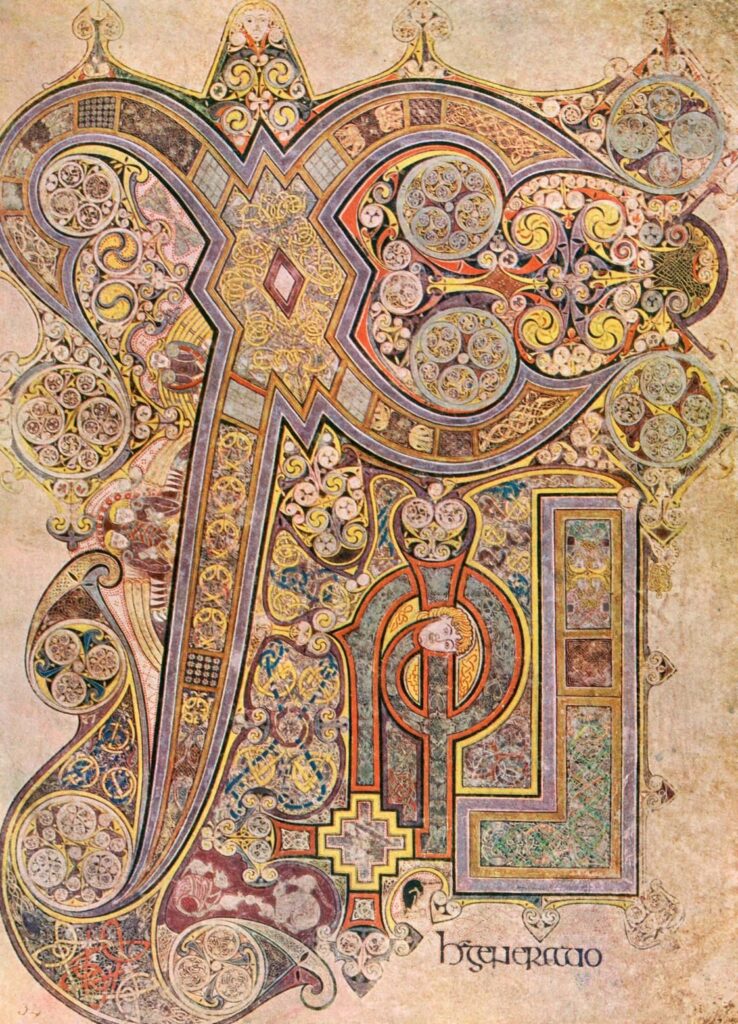
Folio 34r, Chi Rho Monogram
All of us in the Medieval Art class (including Sorensen) had a chuckle when we opened one of our textbooks and found a photo of the sculpture of Saint Peter (Saint Pierre) from Moissac in France. It reminded us of our professor!
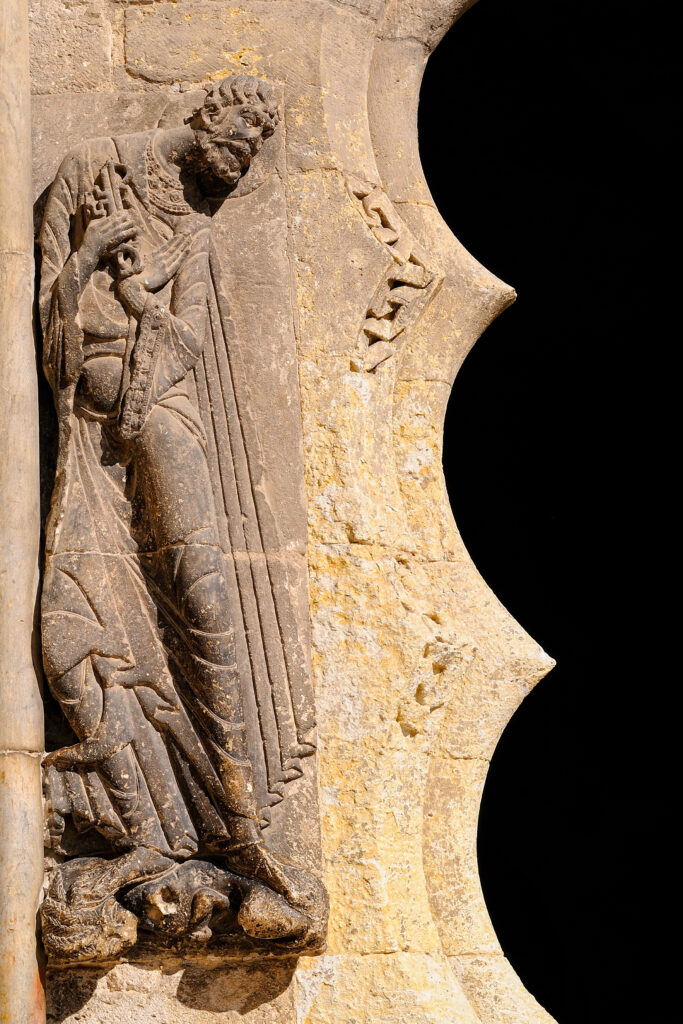
Abbey St-Pierre, Moissac, France
Sorensen had a wonderful sense of humor. One of the things I really appreciated about him was he didn’t always take art history too seriously. Please don’t misunderstand: he was an excellent scholar, who as a teacher, encouraged his students to think critically and to do careful work. He also realized though that some art historians get so wrapped up in their own theories that they can no longer see the works of art that they are studying. Rather than let the art work drive the theory, it becomes the other way around. They have to fit the theory to the art whether it works or not.
Sorensen was also very honest. One time the Furman newspaper had asked him to write a review of an Andrew Wyeth exhibit at a local museum. He declined. It’s not that he didn’t have time. He could have written it, but he chose not to, because he knew he would have to be honest. He called me into the Art Department office and asked me if I wanted to write it. I didn’t have the same opinion about the exhibit that he did so I could honestly write a more positive review.
The last time I saw Sorensen was in 1995 when he and a group of his students came into the Mint Museum of Art. I heard from him shortly before his retirement party in 2003. At that time it was not good timing for me to go out of town to attend the party so I had to decline. We did communicate then. I wish I had stayed in touch with him. I thought of him often and wondered how he was doing. It must have been very hard on him to lose Joan and others that he loved. I hope he knew that he had made a positive difference in my life and in the lives of so many others. On the Washington DC trip, we once stopped at a Roy Rogers Restaurant. Sorensen got a big kick out of the “Happy Trails to you.” So maybe I ‘ll just say, “Happy Trails, Sorensen.”