
The Memphis Academy of Art
About the Academy
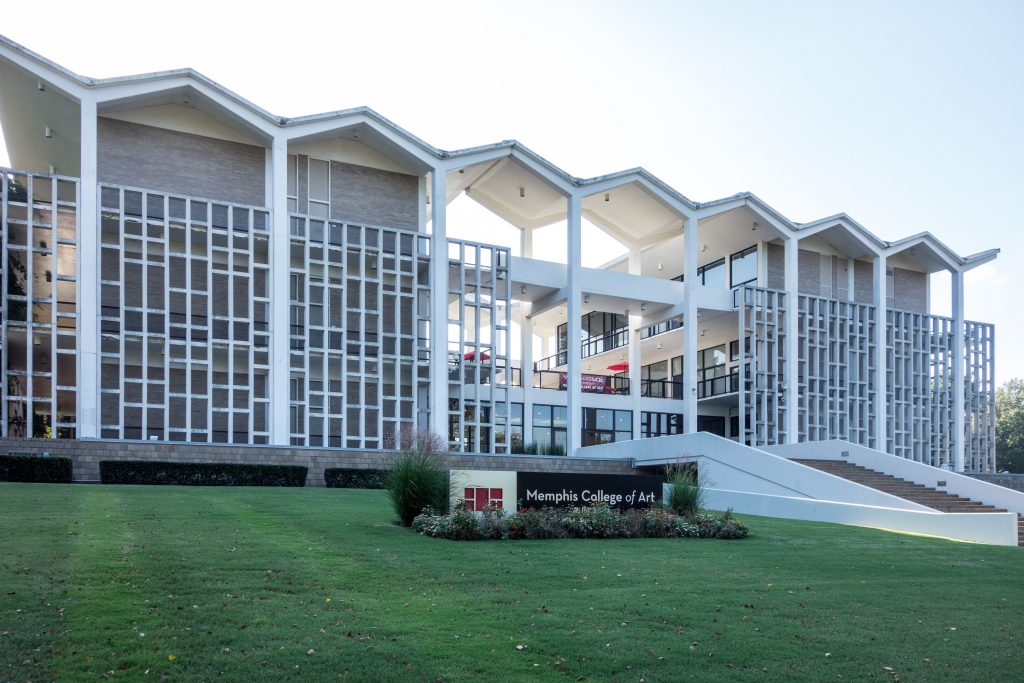
The Memphis Academy of Art was a magical place if you were a child. The building itself was impressive; it was mid-century modern style and dated from 1959, when the art school moved into it from a mid-19th-century historic house. The architect for the new building was Roy Harrover of the architectural firm Harrover and Mann. The art school had been founded in 1936. Initially it was called the Mid-South School of Fine Arts, a name that was soon changed to the Memphis Academy of Art. The Academy kept its name until 1985 when it became the Memphis College of Art. Tragically, it had to close in 2020 for financial reasons.
There had been a predecessor art school to the Academy that was funded by the Memphis Art Association. The Association’s director did not like modern art. Since the school wanted to embrace modernism, it severed ties with the Association and became the now independent Academy. If you want to know more about the Academy’s history or its architect, please see the “Links” section to the right (or below).
A Great Opportunity
When I was in third grade at Bethel Grove Elementary School in Memphis, Tennessee, my teacher, Mrs. Irma Roberts, suggested to Mama and Daddy that they send me to the Academy. The Academy offered art classes for pre-college level students during the summers and on Saturdays. The college professors taught these classes. Although I am sure it was an expense for my parents (not only tuition but the art supplies), I was glad to go. I have always been grateful to Mrs. Roberts and my parents for this opportunity.
As a child I was a big fan of what I called “modernistic” architecture. You can only imagine that I loved the Academy building. It seemed huge — although mostly we stayed in a studio classroom. One time I saw a skeleton at the Academy. It didn’t really scare me, but it was something that you don’t see everyday! :)
My first class at the Academy was the summer after my third grade academic year. I have little to no memories of my fellow art students. I think this was so because once I started doing my art it became my entire focus.
Mr. Callicott
What I do remember were some of the things we did and our teacher, Burton Callicott. As a child, and really only until more recently, have I learned anything about Mr. Callicott’s art. He started teaching at the Academy in 1937, long before my time there. He continued teaching at the Academy until 1973. What I most remember about him was that he made art fun and that he was a kind and patient man.
During one class session he told us a story, and we had to illustrate it. Another time he had us draw our pets. I drew my collie Prince as he was doing his morning stretch. Mr. Callicott told Mama to look at how I had drawn my dog in comparison with the drawings from the other children. He pointed out that most of the drawings were in profile, and drawing an animal in profile is the easiest way to draw it. Instead I had drawn Prince from the front, with his legs outstretched in front of him and his hind quarters up in the air. Mr. Callicott told Mama I had used something called “foreshortening.” I had no idea what that meant at the time. When I chose to depict Prince from the front, I wasn’t thinking “easy” or “hard.” I was just trying to show him in my favorite pose that he would make in the mornings.
During one class we went to the formal gardens in Overton Park to draw the flowers and trees. The Memphis Academy of Art was located in Overton Park so it was a convenient walk to the gardens (see the map on the website in the “Links” section at right or below). For this art we were using pastels. Although I was familiar with blackboard chalk, this was a my first experience with artist pastels. It was a typical hot, muggy Memphis summer day. I sweated a lot and wiped my face with my hands. Since I was also blending the pastels with my fingers, I got a lot of pastel pigment all over me. What a mess! It was a fun mess though.
At the Academy
After that summer and Mr. Callicott, I took some Saturday art classes during the school year with another Academy teacher, a lady. One of my favorite memories was going into a lower level room with tables that were arranged end-to-end so as to create one long table. It was right before Christmas. All along the length of this “mega table” were boxes and containers of all kinds of materials — pipe cleaners, different kinds of paper, wire, cotton, netting. Using these materials, we could make anything we wanted for Christmas. I made an angel.
I remember also an art exhibit that we had at the Academy. I was so proud to have an art work exhibited. As I recall, it was a mixed media work (collage and more) of a winter scene. Mr. Callicott told Mama that he hoped that once I graduated from high school that I would come back and be a student there. It made me feel good to know that he saw potential in an elementary kid who loved art.
A Magical Place and Time
I never wanted to leave the Academy. I was always one of the students lagging behind, and Mama just about had to drag me home. I think if I could have set up a bed and kitchenette and lived there that I would have. It was not to be, however. In January of 1964, we moved to Charlotte, North Carolina. The following summer my parents gave me art lessons at the Mint Museum of Art in Charlotte. Although I always enjoyed my art classes, these classes just weren’t the same. It was never the magical place of my childhood.
When it came time for me to go to college, instead of going to the Memphis Academy of Art, I went to Furman University, in Greenville, South Carolina. I made the choice to go to regular college since I felt it would be better academic preparation for my career and any future education. If I am being truly honest, I also didn’t want to go very far from my parents’ home. I sometimes wonder how my life would have been if I had returned to the Academy.
I still miss the Academy. I miss Mr. Callicott, who passed away in 2003. After that class with him at the Academy, I never had any contact with him. I never forgot him or his encouragement for my art. My home page on this site features one of his quotations: “Art is a rainbow.” RIP, Mr. Callicott. Thank you for your encouragement. RIP, Memphis Academy of Art.
It is only in the recent years that I discovered Mr. Callicott’s rainbow quote and learned that he had done a series of paintings with the rainbow motif. All my life I have loved rainbows, considered them very special, and have collected items with rainbows on them.
If you would like to know more about Burton Callicott, please view the links to the right (or below) in the “Links” section.
Links
- “Memphis College of Art” (Wikipedia article)
- Overton Park (map), Memphis, Tennessee
- “Burton Callicott” (Theosophy Wiki article)
- “The Two Burtons Delve into Faith and Life” (Memphis: The City Magazine article)
- “Burton Callicott” (Tennessee Arts Commission directory entry)
- “Burton Callicott” (Tennessee Encyclopedia article)
- David Lusk Gallery (Mr. Callicott’s art work)
- The Johnson Collection, LLC (Mr. Callicott’s art work)
- “Roy Harrover” (Wikipedia article)
- Mint Museum of Art in Charlotte, North Carolina
Photo Credit: The photo of the Memphis Academy of Art/Memphis College of Art is courtesy of Kenneth C. Zirkel. This work is licensed to the public under the Creative Commons Attribution-ShareAlike 3.0 Unported License (link below).